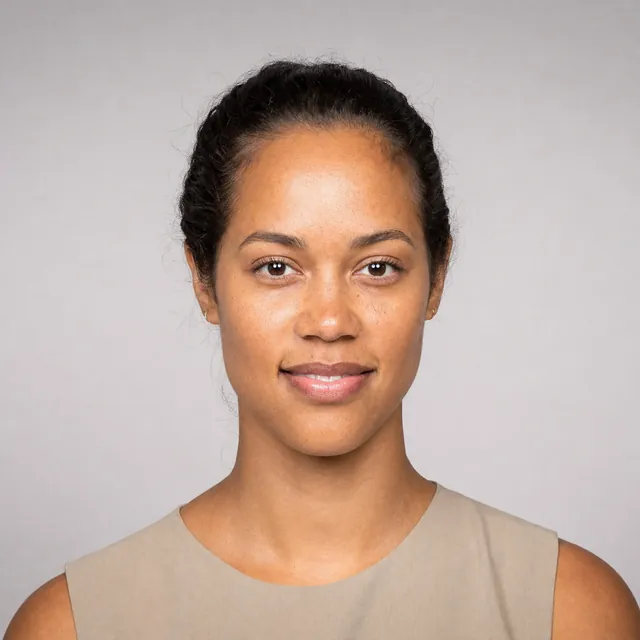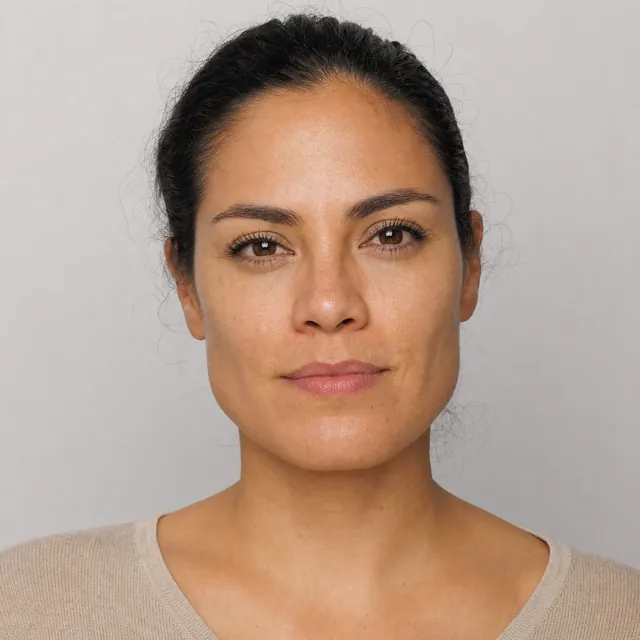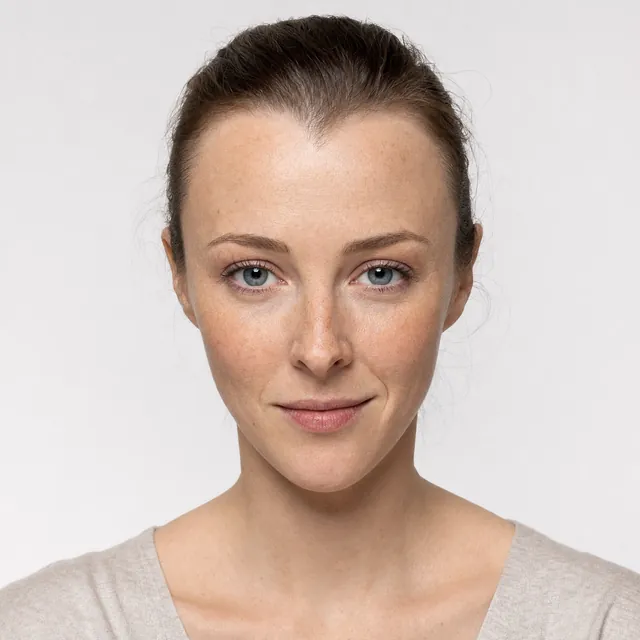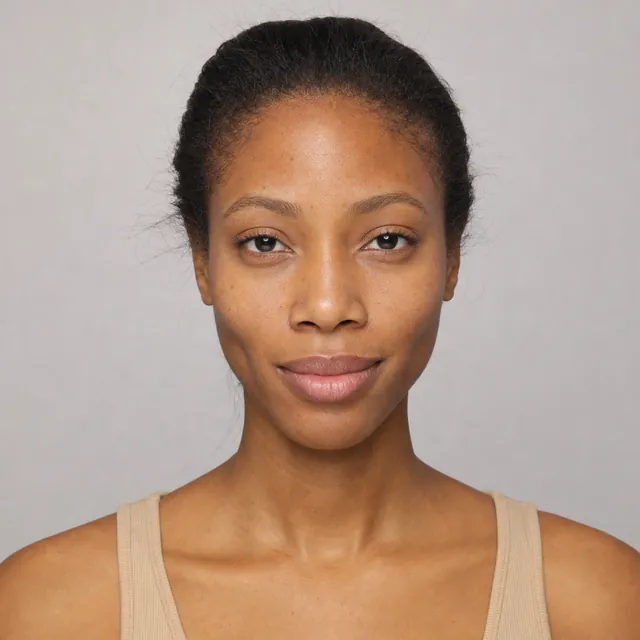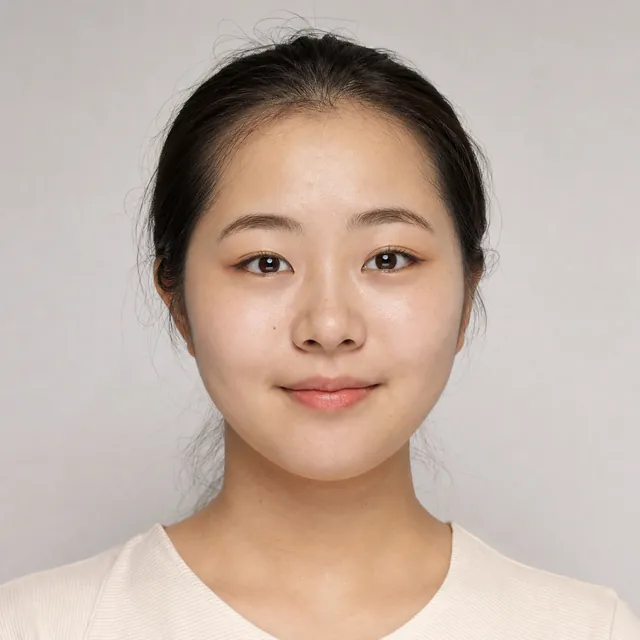
More people misdiagnose themselves as round than any other face shape. Full cheeks, a soft chin, or a little extra weight will push someone toward the round label even when their underlying proportions are oval or square. The actual definition has less to do with softness and more to do with a single ratio: a round face is nearly as wide as it is long.
Below you'll find the measurable traits that define a round face, a quick way to test yourself in the mirror, and the styling logic that follows. Makeup and frame advice for this shape mostly comes down to one idea, adding lines and length to a face built from curves, and once you understand why, you can improvise beyond any list of rules.
What Is a Round Face?
A round face measures nearly the same across the cheekbones as it does from hairline to chin, typically within about ten percent. The cheekbones are the widest zone, but instead of tapering down to a distinct jawline, the outline curves continuously. There is no visible corner where the jaw turns beneath the ear, the chin rounds off without a point, and the hairline usually arcs as well, closing the circle at the top.
Three traits together make the diagnosis:
- A length-to-width ratio close to 1:1, which is the defining measurement
- Cheeks that form the widest part of the face, with fullness that sits low rather than high on the bone
- A jaw and chin with no hard angles anywhere along the curve
Keep the shape distinct from its neighbors. A square face can be just as wide, but it has a pronounced jaw corner and a flatter chin line. An oval face shares the soft jaw but carries noticeably more length. Round is the only category where both conditions hold at once: compact proportions and an outline drawn entirely in curves.
One more distinction saves a lot of confusion. Cheek fullness is soft tissue; face shape is bone. Plenty of oval-faced people have plump cheeks and read as round in photos, especially straight-on with flat lighting. If you slim down and a jaw corner emerges, the roundness was fullness, not structure.
How to Tell If You Have a Round Face
Try the outline trace before you reach for a measuring tape. Stand square to a mirror at arm's length, close one eye, and trace the outline of your face on the glass with a dry-erase marker or a dab of soap. Step back and look at the drawing rather than your face. A round face leaves a shape that is about as wide as it is tall, with no straight segments along the sides and no point at the chin.
Then confirm with numbers. Measure across your cheekbones just below the outer corners of your eyes, and from the center of your hairline to the bottom of your chin. If the two figures are within roughly half an inch of each other, you're in round territory. As a final check, press your fingertips along the edge of your jaw from ear to chin. Finding no distinct corner along the way is the signature of this shape.
Borderline results are common, because faces mix categories more often than they match one. If your trace looks round but your measurements lean longer, or the jaw check turns up a subtle angle, upload a photo to the free AI face shape test and let it measure the landmark distances precisely. For the manual deep-dive, our walkthrough on how to determine your face shape breaks the face into three zones and shows what to look for in each.
Makeup & Contouring for Round Faces
Every technique for a round face pushes in the same direction: build vertical emphasis. The face already has width and softness in surplus, so shadows go on the sides and light goes down the middle. Contour runs along the outer edge of the face, from the temples down over the sides of the cheeks and along the jawline, always blended so the darkest part hugs the perimeter. Under the cheekbone, angle the contour line toward the corner of the mouth rather than straight back, which carves a diagonal into a face that has none.
Highlight forms a vertical strip: center of the forehead, down the bridge of the nose, the chin. That bright column draws the eye up and down instead of side to side, and it does more for perceived length than any amount of side shading. Blush sits slightly above the apples, swept toward the temples, because color placed low and central adds width right where the face is already widest.
Brows and lips help more than most guides admit. An arched brow adds a peak, one of the few angles available on a round face, while a flat straight brow widens it. A slightly overlined cupid's bow points vertically. If you want a full routine built around these principles, our round face makeup guide covers base, eyes, and lips step by step, and the contouring guide shows exact placement diagrams for this shape.
Best Glasses & Sunglasses for Round Faces
Angular frames earn their reputation here. Rectangular and square glasses introduce the straight lines and corners that a round face lacks, which sharpens the cheeks and makes the whole face read as longer. Wayfarers do this while staying casual, and an angular cat-eye adds lift at the temples on top of the structure. Browline frames, with their strong horizontal bar across the top, give the upper face definition that the soft hairline doesn't provide.
Width matters as much as shape. Pick frames that extend just slightly beyond the widest part of your cheeks, so the glasses, and not the face, set the horizontal boundary. A high or keyhole bridge helps too, lengthening the nose visually and adding to the vertical story. Darker rims outperform light ones on this shape because they hold a crisp line against soft features.
The frames that fight you are the ones that mirror the face: small circular lenses, rounded rimless styles, and short narrow frames that sit like a band across the widest zone. For sunglasses, oversized squares and shield styles work well, and a gradient lens keeps a big frame from looking heavy. If you wear earrings, long linear drops and rectangular dangles carry the same lengthening logic below the jaw, while big round hoops repeat the curve you're trying to offset.
Celebrity Examples of Round Faces
Selena Gomez is the example nearly every guide reaches for, with cheek-led width, a curved jaw, and length and width in near balance. Ginnifer Goodwin shows the same geometry with even softer transitions, which is why stylists so often use her as the round reference when explaining frame choices.
Kirsten Dunst and Adele both carry rounded outlines where the chin blends into the jaw without a defined corner, and both demonstrate how well strong eye makeup plays on this shape. Among men, Leonardo DiCaprio has been the standing example since his twenties: compact proportions and a soft jawline that kept his face boyish well into middle age. That association between round faces and youthfulness comes up in perception research too, since rounded features and fuller cheeks are traits we read as younger.
A caution that applies to every list like this: celebrity faces get photographed from every angle under every kind of light, and the same person can look round in one frame and oval in the next. Use these examples to calibrate your eye, then trust your own measurements.
Frequently Asked Questions
What is the difference between a round face and an oval face?
The ratio of length to width. A round face measures nearly the same in both directions, usually within about ten percent, while an oval face is roughly one and a half times longer than it is wide. Both shapes share a soft jaw and rounded chin, which is why they get confused, so the tiebreaker is always the length measurement.
Does gaining or losing weight change a round face?
Weight changes the fullness of your cheeks but not the bone structure underneath. Someone with oval proportions can look round at a higher weight, and a person with a genuinely round skull structure keeps a soft, wide outline even when lean. If your face slims down and a hard jaw corner appears, you were never structurally round.
Which glasses should people with round faces avoid?
Small circular frames are the usual miss, because they repeat the curve of the face and make the cheeks look wider by comparison. Rimless styles with rounded lenses and short, narrow frames have a similar effect. Rectangular, square, and angular cat-eye frames do the opposite job by introducing lines the face doesn't have naturally.
Where should blush go on a round face?
Slightly above the apples of the cheeks, angled up toward the temples. Placing blush directly on the apples widens the center of the face, which is the one direction a round face doesn't need. The upward angle creates lift and a bit of visual length instead.
Is a round face the same as a full face?
No. Fullness describes the soft tissue sitting over the bones, while face shape describes the proportions of the skull. You can have a full oval face or a lean round one. The classification depends on your length-to-width ratio and jawline angle, not on how much your cheeks project.
Related Reading
- Best Makeup for a Round Face Shape: a full routine written specifically for this shape.
- How to Contour for Your Face Shape: placement maps for round and every other shape.
- How to Determine Your Face Shape: the three-zone method explained in depth.
- More guides on the Test My Face blog, or start with the free face shape analyzer.