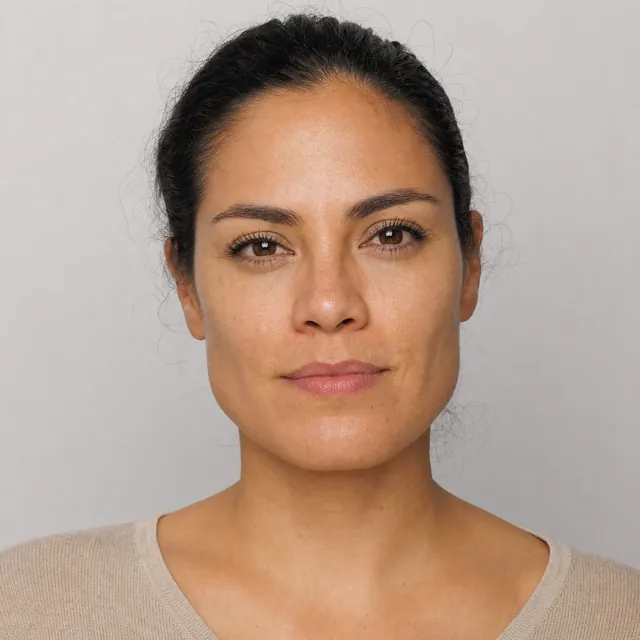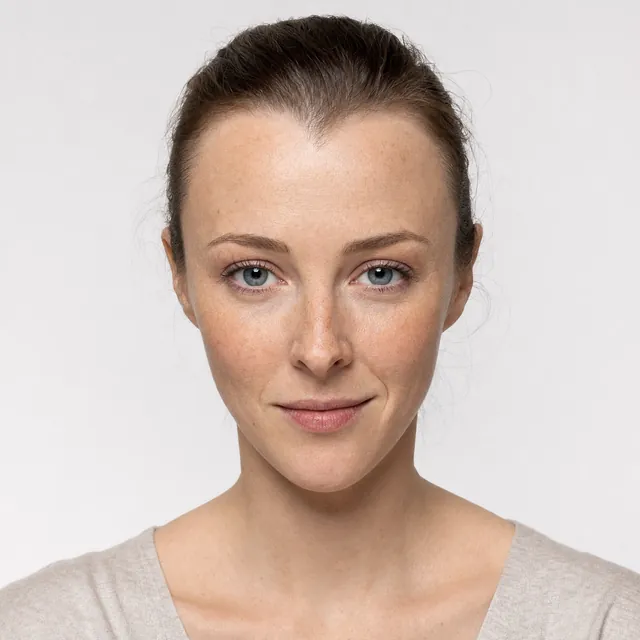
Every face shape is defined by where its width sits, and the heart shape carries its width at the top. The forehead and upper cheekbones form the broadest zone, then the face narrows steadily through the lower cheeks and jaw until it finishes in a small, often pointed chin. Seen straight on, the outline traces the top half of a heart, which is how the category got its name long before anyone was measuring faces with AI.
People usually discover they're heart-shaped in one of two ways: a stylist points out that their chin is doing a lot of tapering, or they notice that top-heavy sunglasses make their forehead look enormous. This guide gives you a more reliable route. You'll learn the three markers that define the shape, how to verify them in a photo, and the balancing principles behind heart-face makeup, frames, and earrings.
What Is a Heart Face?
Three measurements make a heart face. The forehead is the widest zone or ties with the cheekbones. The jaw is clearly narrower than both, without the corner you'd find on a square face. And the chin tapers to a soft point rather than finishing flat or round. Face length usually falls in the middle range, similar to an oval, so it's the top-to-bottom narrowing, not the length, that carries the classification.
The proportions produce a recognizable balance of features. The eyes and brow area feel prominent because the upper face has the most room, cheekbones angle inward as they descend, and the lower face looks delicate by comparison. In profile, heart-shaped faces often show a slightly forward chin point, which keeps the small chin from disappearing under the mouth.
A widow's peak gets mentioned in almost every heart-face description, and it deserves demystifying. The V-shaped dip in the center hairline echoes the heart outline nicely, but it's a hairline trait inherited independently of bone structure. It shows up on square, oval, and round faces too. Treat it as decoration on the classification, never the basis of it.
Heart is also the shape most often confused with two neighbors. Diamond faces share the pointed chin but have a narrow forehead, with all the width concentrated in the cheekbones. Inverted triangle faces share the wide top but run straighter along the sides, with a more abrupt chin. If your forehead is broad and your chin comes to a gentle point, heart is your category.
How to Tell If You Have a Heart Face
A straight-on photo beats a mirror for this shape, because the diagnosis depends on comparing zones that are hard to see at once. Take a front-facing picture with your face fully visible from hairline to chin, then check three things in order.
- Cover the lower half of the image with your hand and judge the top: a heart face shows a forehead as wide as, or wider than, the cheekbones.
- Uncover the photo and follow the sides of the face downward: the outline should move steadily inward from the temples, with no widening at the jaw.
- Look at the chin on its own: a taper to a soft point, noticeably narrower than the mouth above it, completes the pattern.
If you want numbers instead of eyeballing, measure forehead, cheekbone, and jaw width as described in our face shape measuring guide; heart faces put the forehead within a quarter inch of the cheekbones or beyond them, with the jaw trailing well behind both. And if your photo assessment keeps flip-flopping between heart and diamond, the free AI face shape test measures the exact landmark distances and picks the category your ratios actually support.
Makeup & Contouring for Heart Faces
Heart-face makeup redistributes visual weight from the top of the face to the bottom. The upper face has surplus width, so the shading goes there: a light pass of contour at the temples and along the sides of the forehead pulls the broadest zone inward. Blend the product up into the hairline's edge so no line shows. That single step does more to balance a heart face than anything else in the routine.
The lower face gets the opposite treatment. Highlight the center of the chin to give the narrow point more presence, and consider a soft focus of color on the lips, since a fuller-looking mouth anchors the small lower third. If the chin's point reads sharper than you'd like, one small dab of contour on the very tip rounds it off. Blush placement is distinctive for this shape: apply it slightly below the apples and blend outward, which fills the visual gap where the face narrows. High, angled blush placement, great on round faces, exaggerates the taper on a heart.
Cheekbone contour is optional and should stay subtle. The bones already angle inward toward the chin, so a heavy diagonal stripe doubles an effect the face performs on its own. Our contouring guide for every face shape includes the heart placement map, and the makeup looks roundup shows finished looks built on these principles.
Best Glasses & Sunglasses for Heart Faces
Frames for a heart face follow one rule: keep the visual weight low. Bottom-heavy silhouettes, lenses that are deeper than they are decorated, and thin or rimless upper edges all shift attention downward, balancing the wide forehead. Aviators are the textbook match because the teardrop lens is widest at the bottom, exactly inverse to the face. Round and oval frames in light materials work for the same reason.
Rimless and semi-rimless builds flatter this shape more than any other, since removing the top bar keeps the brow area from doubling up on width. If you prefer full rims, choose light colors or translucent acetates over heavy black, and keep the frame width within the line of your forehead rather than extending past it. Low-set or curved temples help too, drawing the eye toward the midface.
The misses are predictable: top-heavy browline frames, decorated upper corners, and oversized cat-eyes that flare at the temples all add width to the widest zone. For sunglasses, gradient lenses that darken at the top and fade toward the bottom suit the shape unusually well. Earrings finish the balancing act. Teardrops, chandeliers, and any drop that widens toward the bottom add presence beside the narrow jaw, doing with jewelry what the aviator lens does with frames.
Celebrity Examples of Heart Faces
Reese Witherspoon is the canonical example, cited so often that her chin practically defines the category: broad forehead, inward-sloping cheeks, and a fine pointed chin. Scarlett Johansson shows the shape with fuller cheeks, proof that the heart classification survives soft tissue as long as the taper holds underneath.
Chloë Grace Moretz carries a younger version of the same geometry, and stylists regularly use her frame choices as heart-face references. Among men, Ryan Gosling is the go-to example: his forehead-to-jaw narrowing is obvious once you look for it, and it's part of why aviators appear in so many of his photographed looks.
The usual caveat applies with extra force for heart faces. This shape is defined partly by the hairline, so pulled-back photos and styled shots of the same celebrity can suggest different categories. Comparing yourself to a photo where the forehead is fully visible gives the honest read.
Frequently Asked Questions
Does a widow's peak mean I have a heart-shaped face?
Not by itself. A widow's peak, the V-shaped dip at the center of the hairline, appears on every face shape and is controlled by different genetics than your bone structure. It reinforces the heart impression when the proportions already fit, but the classification rests on a wide forehead, narrower jaw, and tapered chin. Plenty of heart-shaped faces have perfectly straight hairlines.
What is the difference between a heart-shaped and a diamond face?
Where the width sits. Both shapes narrow to a pointed chin, but a heart face is widest at the forehead or ties the forehead with the cheekbones, while a diamond face has a visibly narrow forehead and gets all of its width from the cheekbones alone. Cover your lower face in a photo and look at the top third: broad means heart, pinched at the temples means diamond.
What earrings suit a heart-shaped face?
Styles that widen toward the bottom, such as teardrops, chandeliers, and triangular drops. They add visual weight beside the narrow jaw and chin, mirroring the balance work that makeup and frames do for this shape. Studs and small hoops are safe everywhere, while heavy top-loaded designs add width at the wrong end.
Should I contour my chin if it's pointed?
Only if the point bothers you. A single dab of contour on the very tip of the chin, blended well, visually shortens it and rounds the profile of the lower face. Many people with heart-shaped faces skip this entirely, since a delicate chin is part of what gives the shape its lift. Test both versions in photos before making it a habit.
Are heart and inverted triangle the same face shape?
They are close relatives, and many systems merge them. Both are wide on top and narrow at the jaw. Where guides separate them, heart implies softer curves at the cheeks with a gently pointed chin, sometimes with a widow's peak, while inverted triangle describes straighter lines from the temples to a more abrupt, angular chin. The styling advice is essentially identical for both.
Related Reading
- How to Determine Your Face Shape: how to read your forehead, cheekbones, and jaw as separate zones.
- How to Contour for Your Face Shape: the heart-face placement map with product picks.
- What Does Your Face Shape Say About You?: the folklore and the research behind shape and personality.
- Browse the full Test My Face blog or start with the free face shape analyzer.