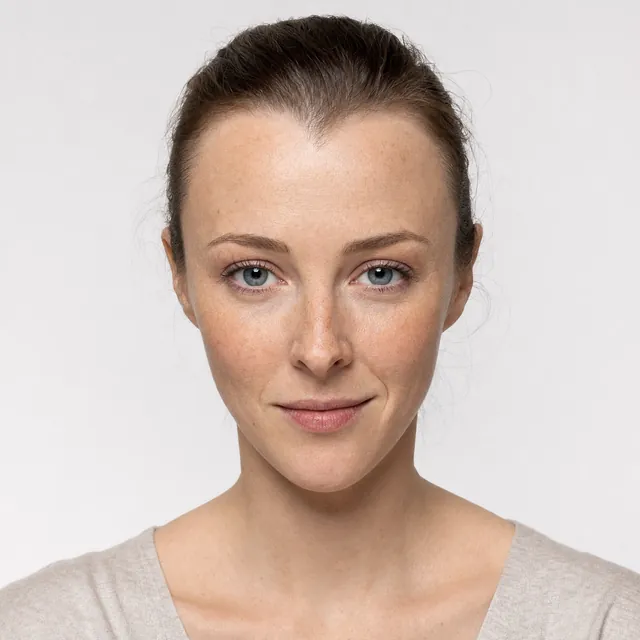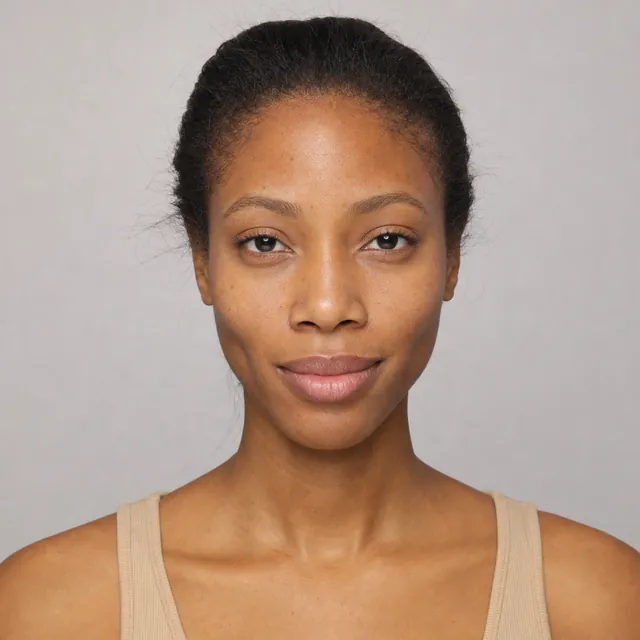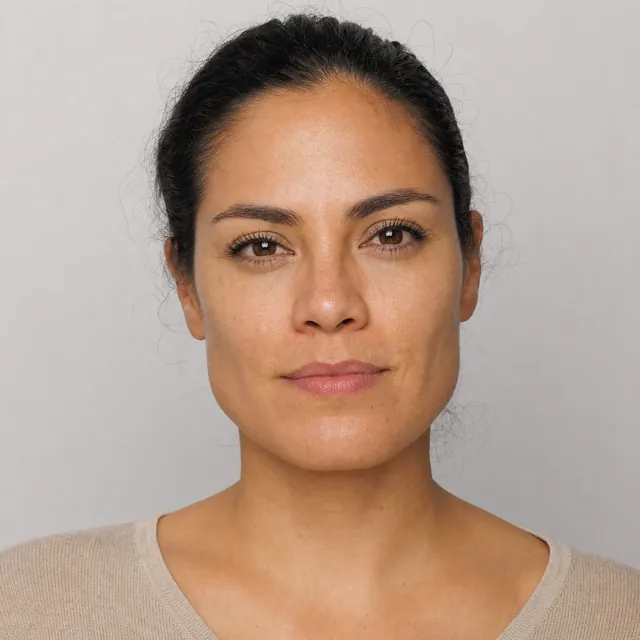
The square face is the easiest shape to spot in a crowd, because its signature feature announces itself: a jawline with an actual corner. Where other shapes curve from ear to chin, a square face turns. That angle, combined with a forehead, cheekbones, and jaw of nearly equal width, produces the strong, architectural look that photographers love and that face shape guides spend most of their time telling people to soften.
Whether you should soften it is a style choice, not a requirement. This page lays out the measurable definition of a square face, a two-minute way to confirm yours, and the makeup and eyewear logic for both directions: playing the angles up or dialing them down.
What Is a Square Face?
A square face keeps roughly the same width from top to bottom. Measure the forehead, the cheekbones, and the jaw, and the three numbers land within about half an inch of one another. Face length stays close to face width, which separates square from the longer rectangular variant. The sides of the face run nearly straight down from the temples, the hairline tends to be flat rather than arched, and the chin finishes wide and level instead of tapering to a point.
The jaw deserves its own paragraph because it carries the whole classification. On most faces, the angle where the jawbone turns upward toward the ear (anatomists call it the gonial angle) is open and gentle, somewhere around 125 degrees, which reads as a smooth curve. On a square face that angle closes toward 90, and the corner becomes visible from the front, not just in profile. Skin and muscle can blur it, but if the corner shows in a straight-on photo, the face belongs in this category.
Square proportions also change how light behaves. Flat planes and hard edges catch highlights and cast defined shadows, which is why square faces photograph with so much natural structure and why they often look contoured with nothing on. Bear that in mind whenever you read makeup advice for this shape: you start with definition other people have to draw on.
How to Tell If You Have a Square Face
Start with touch rather than sight. Place a fingertip just below each earlobe and slide down along the edge of the jawbone toward your chin. On a square face you'll feel a definite corner within the first inch, a point where the bone changes direction sharply. Faces without that corner curve the whole way, however wide they are.
Next, compare widths in a mirror or a straight-on photo. Hold a pencil vertically at the outer edge of your forehead and check whether your cheekbone and jaw extend past it. On a square face all three zones touch roughly the same vertical line, so the pencil stays flush from temple to jaw. Finally, glance at your chin: level and broad supports the square call, while a chin that narrows to a point pushes you toward heart or diamond even if your jaw is strong.
Length is the last checkpoint. If your face is clearly longer than it is wide but the jaw still has that corner, you're likely rectangular, which most systems group with oblong. If you want the measurements handled for you, the free AI face test maps your jawline landmarks from one photo, and our guide on determining your face shape covers the manual method zone by zone.
Makeup & Contouring for Square Faces
Square-face contouring concentrates on four small areas: the two corners of the jaw and the two corners of the forehead. A matte contour shade blended over each corner rounds the outline just enough to soften the geometry, and because the target zones are small, this is quick work. Blend upward at the jaw and inward at the temples, and keep the product light; a square face over-contoured at the perimeter starts to look narrower than its own cheekbones.
Everything else moves toward curves and center focus. Blush goes on the rounded apples of the cheeks in circular strokes, not swept along the cheekbone in a straight line, since diagonal streaks echo the angles you're softening. Highlight belongs down the middle: forehead center, nose bridge, cupid's bow, and the middle of the chin, drawing attention away from the wide corners. Rounded, tapered brows suit the shape better than sharply squared ones, and a soft gradient lip finishes the effect.
The reverse styling is just as legitimate. Keeping the jaw bare, adding a crisp winged liner, and placing highlighter on the jaw corner itself turns the angularity into the centerpiece, a look that runs through decades of editorial photography. Placement maps for both approaches are in our complete contouring guide, and our roundup of makeup looks by face shape includes full square-face looks.
Best Glasses & Sunglasses for Square Faces
Frames with curves balance a face built from straight lines. Round lenses are the classic pairing, and they work best sized generously, since tiny circles can look lost against a broad jaw. Ovals give you the same softening with a lower profile. Aviators suit square faces particularly well because the teardrop lens narrows toward the bottom exactly where the jaw is widest, and a soft cat-eye adds lift without adding corners.
Construction matters alongside silhouette. Thin metal rims, semi-rimless builds, and rimless styles keep the frame lightweight against strong bone structure, while thick black rectangles stack angles on angles. If you prefer bold frames, choose one with visibly rounded corners and a width that matches your cheekbones rather than extending past the jaw.
For sunglasses, round metal frames, oversized ovals, and aviators cover the flattering end of the range; wraparound and boxy shield styles sit at the other. Accessories follow the same softening rule. Round hoops and curved teardrop earrings play against the jaw angle, and they're a better match than long straight bars, which mirror the vertical sides of the face. A square face wearing circular earrings gets the same contrast effect a round face gets from rectangular glasses, just in reverse.
Celebrity Examples of Square Faces
Angelina Jolie is probably the most analyzed square face in film, with a jaw corner visible from the front and forehead, cheek, and jaw widths in close alignment. Olivia Wilde is the example eyewear guides reach for, since her face shows how well round and aviator frames sit against an angular jaw. Keira Knightley carries a slightly longer variant, with the strong mandible reading clearly in profile shots.
Demi Moore has built four decades of red-carpet looks around square proportions, usually with the center-focused makeup described above. Among men, Brad Pitt remains the reference: his gonial angle is sharp enough that lighting designers can carve his jaw with a single source. None of these faces has ever needed correcting, which says something about how to read the softening advice on this page. It's a set of options, not a repair manual.
Frequently Asked Questions
How is a square face different from a round face?
Both shapes have compact proportions, with length and width close to equal, but they part ways at the jaw. A square face has a clearly defined corner where the jaw turns up toward the ear and a relatively flat chin line, while a round face curves continuously from cheek to chin with no corner at all. Run a finger along your jawline: feeling a distinct angle points to square.
Is a square face the same as a rectangular face?
They share the strong jaw and even widths, but not the length. A square face is about as long as it is wide. A rectangular face, which most systems file under oblong, carries the same angular jaw on a face that is noticeably longer than its width. If your jaw is sharp and your face length clearly exceeds your cheekbone width, look at the oblong category instead.
Can makeup soften a square jawline?
Yes, and it takes less product than most tutorials suggest. A small amount of contour blended over the corners of the jaw, just where the bone turns, dials the angle back without erasing it. Rounded blush placement on the apples of the cheeks and a highlight limited to the center of the face shift attention inward, away from the perimeter angles.
What sunglasses look best on a square face?
Curved silhouettes: round lenses, ovals, aviators, and soft cat-eye styles. These counter the straight lines of the jaw and forehead instead of repeating them. Thin metal rims and rimless builds work especially well because they keep the frame from adding more visual weight to a face that already has strong structure.
Are square faces considered attractive?
A defined jawline is one of the most photographed features in fashion and film, and casting directors have prized it for decades because it holds light and shadow so well. No face shape is objectively more attractive than another, but square is arguably the one that styling guides tell people to change the least.
Related Reading
- How to Determine Your Face Shape: measure your jaw, cheekbones, and forehead the right way.
- How to Contour for Your Face Shape: corner-softening placement for square faces, with diagrams.
- Top Makeup Looks for Different Face Shapes: complete looks that work with strong angles.
- Find more guides on the Test My Face blog or check your shape with the free face analyzer.