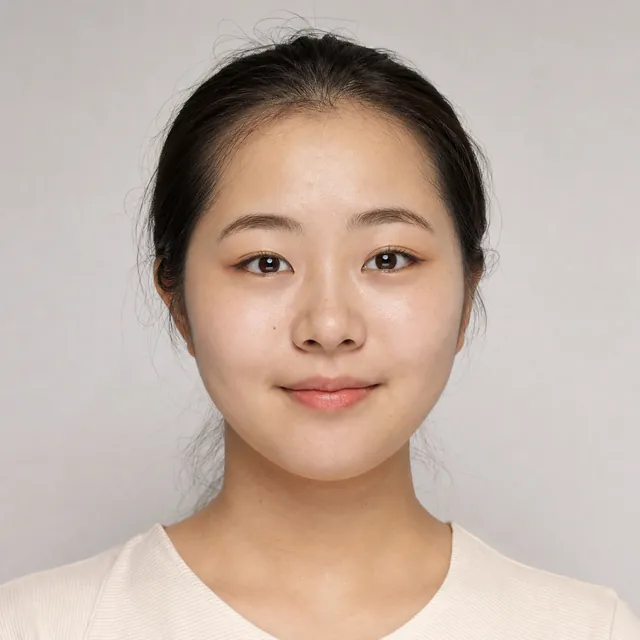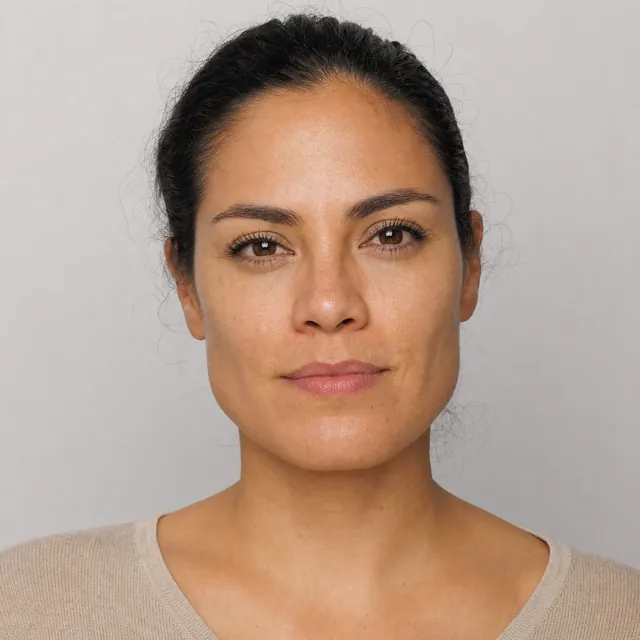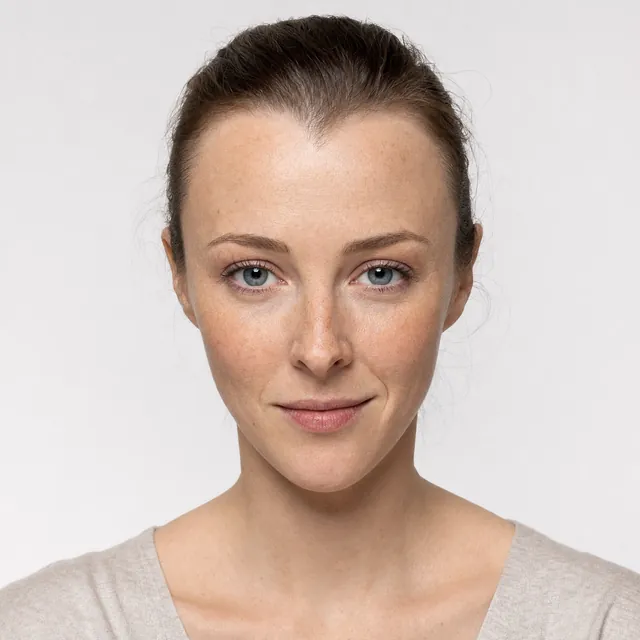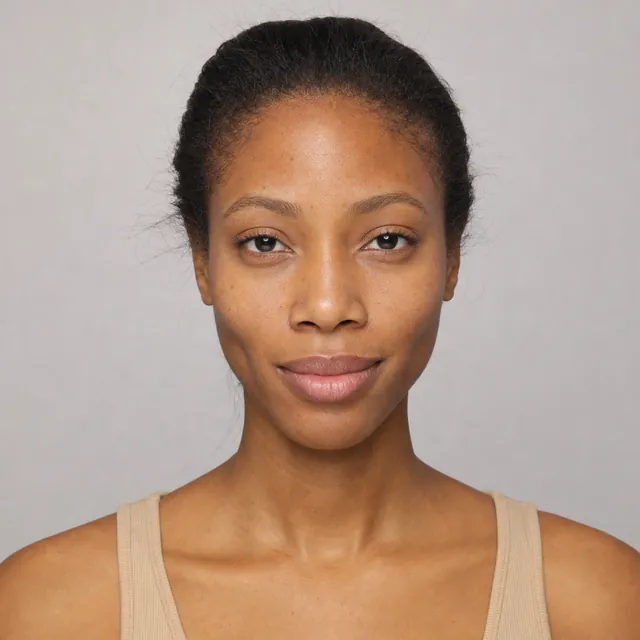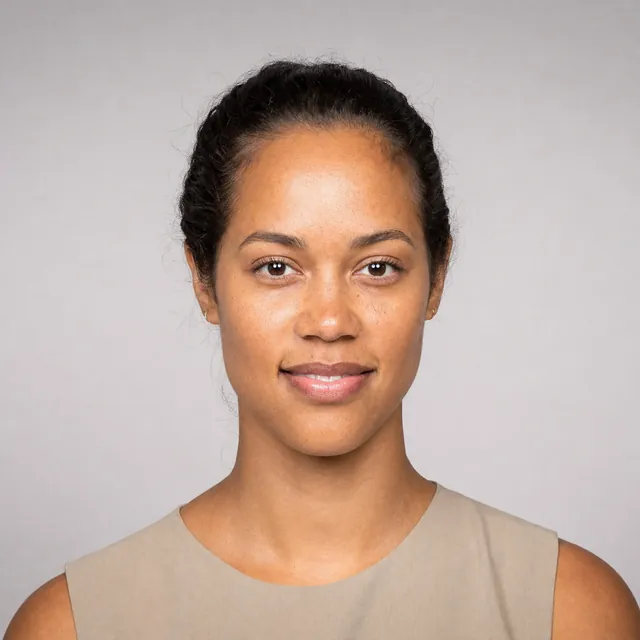
Nearly every face shape system treats oval as its reference point, and there is a practical reason for that. The proportions sit in the middle of the range: the face is longer than it is wide, the cheekbones are the widest point, and the jaw curves down to the chin without a hard angle anywhere. No single feature dominates, so styling advice written for an oval face rarely needs correcting for width or length.
This guide covers what defines an oval face in measurable terms and how to check whether your own face fits. It also gets into what the shape means when you choose makeup, glasses, and earrings, since "everything works" is true for oval faces only up to a point. Scale and placement still matter.
What Is an Oval Face?
An oval face is about one and a half times longer than it is wide. Measure from the hairline to the tip of the chin, then across the cheekbones at their widest point, and the first number lands somewhere between 1.4 and 1.6 times the second. The forehead is a touch narrower than the cheekbones, the jaw is narrower still, and the outline tapers smoothly toward a rounded chin. Picture an egg standing on its narrow end and you have the silhouette guides are describing.
| Feature | What you see on an oval face |
|---|---|
| Length to width | Roughly 1.5:1, measured hairline to chin against cheekbone width |
| Cheekbones | The widest zone of the face, gently prominent |
| Forehead | Slightly narrower than the cheekbones, wider than the jaw |
| Jawline | Curved and soft, with no visible corner below the ears |
| Chin | Rounded, neither pointed nor squared off |
The gradual taper is what separates oval from its neighbors. A round face has similar softness but nearly equal length and width. An oblong face keeps the length but loses the taper, with forehead, cheeks, and jaw all measuring close to the same. A heart face tapers too, but far more sharply, ending in a pointed chin under a wide forehead. On an oval face, every transition is gentle and the widths step down evenly as you move from top to bottom.
Real faces rarely match the textbook version exactly. Plenty of people have oval proportions with a slightly squared chin, or an oval outline with cheekbones that barely project. The label describes the overall geometry, and the closer your measurements sit to the ratios above, the more confidently you can borrow any advice written for oval faces.
How to Tell If You Have an Oval Face
You need four numbers and a soft measuring tape. A piece of string held against a ruler works if you don't have a tape.
- Measure your face length from the center of your hairline straight down to the tip of your chin.
- Measure your forehead across its widest section, usually about halfway between your eyebrows and hairline.
- Measure across your cheekbones, starting and ending just below the outer corner of each eye.
- Measure your jaw from the corner below one ear to the middle of your chin, then double that figure.
Now run three checks. First, divide length by cheekbone width; an oval face gives you roughly 1.4 to 1.6. Second, compare the three widths; the cheekbones should be the largest number, with the forehead second and the jaw smallest. Third, trace your jawline with your fingertips from ear to chin. On an oval face the line curves the whole way down and you never hit a distinct corner.
If two of the checks pass and one fails, you are probably an oval with a borrowed trait, like a slightly wide jaw or a longer midface. If you keep getting numbers that straddle two categories, our free AI face test measures the same landmarks from a photo and tells you which shape your proportions match most closely. The zone-by-zone method in our guide to determining your face shape is another good tiebreaker, since it looks at each region of the face separately instead of forcing a single label.
Makeup & Contouring for Oval Faces
The working principle for oval makeup is enhancement rather than correction. Other shapes use contour to lengthen, shorten, or soften something specific. An oval face has nothing to counterbalance, so heavy sculpting tends to create problems where none existed. Shade the jawline hard enough and you erase the taper that makes the shape read as oval in the first place.
Contour lives in one place: under the cheekbones. Suck in your cheeks, find the hollow, and run a light stripe from the top of the ear toward the corner of the mouth, stopping about two finger-widths away from the lips. Blend upward. This restores the shadow your foundation covered rather than inventing a new one. Our contouring guide for every face shape walks through the technique with product recommendations if you want the full method.
Blush goes on the apples of the cheeks, blended back toward the top of the ear. Because the midface is already the widest zone, you don't need to angle the blush up for lift or drag it low for balance; the natural placement works. Highlighter follows the high points: tops of the cheekbones, brow bone, bridge of the nose, and the cupid's bow.
The eyes and lips are where an oval face has the most room to play. A strong winged liner, a dark smoky eye, or a saturated lip won't fight the geometry of the face, which is why so many editorial looks are photographed on oval-faced models. If you tend to keep your base minimal, one defined feature is usually enough to make the whole face look finished.
Best Glasses & Sunglasses for Oval Faces
Frame shopping is genuinely easier with an oval face because there are no angles to soften and no width extremes to offset. Rectangular frames add structure that the soft outline doesn't have on its own. Aviators and wayfarers echo the natural taper. Cat-eye styles lift the midface, and round lenses lean into the softness for a more relaxed look. All of these sit comfortably on oval proportions.
The one rule worth keeping is scale. Choose frames about as wide as your face at the cheekbones, give or take a few millimeters. Oversized frames that extend well past the temples swallow balanced features, and tiny lenses can leave the midface looking longer than it is. Depth matters too: the bottom of the lens should sit above the line of your cheek, so the frame doesn't press into your smile.
For sunglasses, the same logic scales up slightly. A moderate oversize works fine for sun coverage, and gradient or lighter-tinted lenses keep a bigger frame from overwhelming the face. Squared frames with softly rounded corners are a reliable default when you want one pair to work with everything.
Earrings follow the same permissive logic. Studs, small hoops, and shoulder-length drops all sit well because the jawline doesn't compete with anything hanging beside it. If your oval runs slightly long, wider earrings such as round hoops add a little horizontal emphasis near the jaw.
Celebrity Examples of Oval Faces
Beyoncé is one of the most consistently cited oval examples. Her face divides into even horizontal thirds, her cheekbones are the widest point, and her jaw tapers gently to a rounded chin. Jessica Alba shows the same geometry with slightly softer cheeks, which is a useful reminder that cheek fullness and bone structure are separate things.
Among men, George Clooney is the standard reference. His forehead is marginally wider than his jaw, and the jawline curves rather than cutting the sharp corner you'd see on a square face. Kate Middleton is another frequently named example, with cheekbone-led width and a chin that rounds off instead of pointing.
You'll notice that different publications sometimes assign these same celebrities to different categories. That isn't sloppiness so much as evidence that real faces blend traits, and that a photo's angle and lighting can shift which features stand out. Treat celebrity comparisons as a sanity check on your own measurements rather than proof by resemblance.
Frequently Asked Questions
Is the oval face shape the most attractive?
There is no objectively best face shape. Oval gets called the balanced shape because most styling rules work on it without adjustment, which makes it a convenient reference point for guides. Research on facial attractiveness points to symmetry and averageness of features rather than any single outline, and every shape has famous faces to prove the point.
What is the difference between an oval and an oblong face?
Length. An oval face is roughly one and a half times longer than it is wide and tapers from the cheekbones down to a narrower, rounded chin. An oblong face runs noticeably longer than that, usually more than 1.6 times its width, and its forehead, cheekbones, and jaw measure closer to the same width, so the sides of the face look straighter.
Do oval faces need contouring?
Contouring is optional on an oval face because there is no width or length imbalance to correct. If you enjoy the sculpted look, a light sweep of contour under the cheekbones restores the natural shadow that foundation covers up. Heavy shading along the jaw or forehead usually works against the shape rather than for it.
Can oval faces wear any glasses?
Almost. Rectangular, aviator, cat-eye, round, and wayfarer frames all sit well on an oval face because there are no strong angles or width extremes to fight. The main thing to watch is scale: keep the frame about as wide as your face at the cheekbones, since oversized frames can swallow balanced proportions and very small lenses can make the midface look longer.
How can I be sure my face is oval?
Take four measurements: face length from hairline to chin, then the width of your forehead, cheekbones, and jaw. If the length is about 1.4 to 1.6 times the cheekbone width, the cheekbones are the widest of the three, and the jaw curves gently to a rounded chin, your face is oval. You can also upload a photo to the free AI face shape detector on testmyface.com and let it run the numbers for you.
Related Reading
- How to Determine Your Face Shape: the zone-by-zone method for reading your own proportions.
- How to Contour for Your Face Shape: placement, products, and blending for all six shapes.
- Top Makeup Looks for Different Face Shapes: full looks matched to each shape.
- Browse every article on the Test My Face blog, or go straight to the free face shape analyzer.